
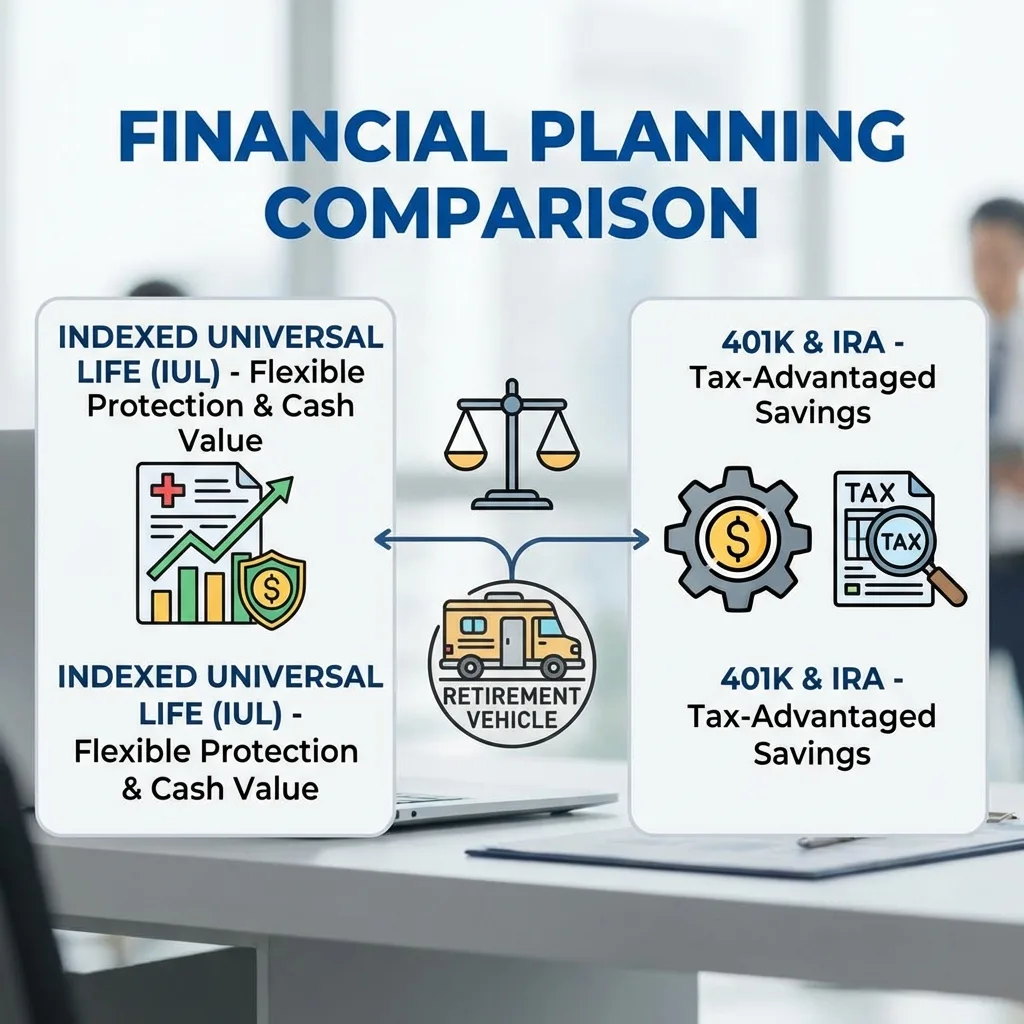
Retirement Vehicle White Paper
Planning for retirement has become increasingly complex, especially with the evolving financial landscape influenced by regulatory changes and market volatility.
Why the Retirement Vehicle You Choose Matters
Most Americans default to a 401k through their employer without ever evaluating whether it is the best retirement vehicle for their specific situation. Yet the difference between a tax-deferred account and a tax-free account can be worth hundreds of thousands of dollars over a 30-year retirement. Understanding IUL vs 401k — and how both compare to IRAs — is one of the most important financial decisions a working adult can make.
Planning for retirement has become increasingly complex, shaped by market volatility, evolving tax policy, and regulatory changes. Traditional retirement vehicles such as 401(k)s and IRAs have long been the go-to options for tax-advantaged savings. However, with developments in IRS codes and innovations in insurance products, Indexed Universal Life (IUL) insurance has emerged as a compelling alternative or complement to traditional accounts — particularly for individuals seeking tax-free retirement income with no required minimum distributions.
This White Paper compares Indexed Universal Life insurance vs 401k and IRA, focusing on tax advantages, contribution flexibility, access rules, risk profile, and long-term wealth accumulation.
How Each Retirement Vehicle Works
401k — Employer-Sponsored Tax-Deferred Savings
A 401(k) is an employer-sponsored retirement plan that allows employees to contribute pre-tax earnings, reducing their taxable income in the year of contribution. Employers may match a percentage of contributions, which is essentially free additional savings.
Contribution limits (2026): $24,500 per year, with an additional $8,000 catch-up contribution for those aged 50 and older ($32,500 total). Per IRS 401k contribution limits, these amounts are adjusted periodically for inflation.
Tax treatment: Contributions are pre-tax (deductible); withdrawals in retirement are taxed as ordinary income. If future tax rates are higher than current rates, this becomes a disadvantage.
Investment options: Typically limited to the mutual funds, target-date funds, and index funds selected by the employer plan administrator.
Required Minimum Distributions (RMDs): Account holders must begin withdrawing a calculated minimum amount starting at age 73, regardless of whether they need the income. Failure to take RMDs results in a 50% excise tax on the shortfall.
Early access: Withdrawals before age 59½ incur a 10% penalty plus ordinary income tax. The CARES Act of 2020 temporarily waived this penalty for COVID-related hardship distributions up to $100,000, but those provisions expired.
For additional regulatory context, see the Department of Labor retirement plan information.
Traditional and Roth IRA
IRAs are individually owned accounts that offer tax-advantaged growth outside of an employer plan. There are two primary types: Traditional and Roth.
Contribution limits (2026): $7,500 per year, with an additional $1,100 catch-up for those aged 50 and older ($8,600 total). Income phase-out limits apply to Roth IRA eligibility and to the deductibility of Traditional IRA contributions when you also have a workplace plan.
Traditional IRA: Contributions may be tax-deductible; withdrawals in retirement are taxed as ordinary income. RMDs apply starting at age 73.
Roth IRA: Contributions are after-tax; qualified withdrawals in retirement are tax-free. Roth IRAs are exempt from RMDs during the account holder's lifetime, making them a powerful tool for tax-free retirement income. However, income eligibility limits apply — single filers earning above $168,000 (2026) cannot contribute directly to a Roth IRA.
Investment options: Broader than a 401k — IRAs can hold stocks, bonds, ETFs, mutual funds, REITs, and more. For investor education on IRA options, the SEC investor education resource provides helpful guidance.
Risk: Like 401k accounts, both Traditional and Roth IRAs are fully exposed to market risk. Account values fluctuate with investment performance, and there is no downside floor.
Indexed Universal Life Insurance (IUL) as a Retirement Vehicle
Indexed universal life insurance for retirement is a form of permanent life insurance that combines a death benefit with a cash value component linked to a stock market index — typically the S&P 500 — without directly investing in the market.
Contribution limits: IUL has no IRS-imposed annual contribution limit. Premiums are guided by IRS Code 7702, which sets the maximum allowable premium relative to the death benefit to prevent the policy from being reclassified as a Modified Endowment Contract (MEC). This means high-income earners can allocate significantly more to an IUL than the $24,500 cap on a 401k.
Tax treatment: Cash value grows on a tax-deferred basis under IRS Code 7702. Policy loans taken against the cash value are not considered taxable distributions — they are treated as debt, not income — enabling tax-free access to retirement funds at any age.
Downside protection: Most IUL policies include a 0% floor, meaning the cash value cannot decrease due to market losses. Growth is credited based on index performance up to a cap or participation rate.
No RMDs: Unlike 401k and Traditional IRA accounts, IUL has no required minimum distributions. You access your cash value when you choose, on your own timeline.
Death benefit: As a permanent life insurance policy, an IUL provides a death benefit to beneficiaries, typically income-tax-free under IRS Code 101(a). This is a component not available in any traditional retirement account.
IUL vs 401k vs IRA: Side-by-Side Comparison Chart
The table below summarizes the key differences when comparing 401k vs IUL and IRA side by side. This IUL vs 401k chart covers the most decision-relevant features:
Feature | 401k | IRA (Traditional / Roth) | IUL |
|---|---|---|---|
2026 Contribution Limit | $24,500 ($32,500 age 50+) | $7,500 ($8,600 age 50+) | No IRS cap (governed by IRS Code 7702) |
Tax on Contributions | Pre-tax (deductible) | Pre-tax (Traditional) or after-tax (Roth) | After-tax (premium paid with post-tax dollars) |
Tax on Withdrawals | Taxed as ordinary income | Taxed (Traditional) or tax-free (Roth) | Tax-free via policy loans (not distributions) |
Required Minimum Distributions | Yes — begins at age 73 | Traditional: Yes at 73. Roth: None | None — access on your own timeline |
Early Access Penalty | 10% penalty before age 59½ | 10% penalty before age 59½ | None — policy loans available at any age |
Market Risk / Downside | Full market exposure; no floor | Full market exposure; no floor | 0% floor — cannot lose to market downturns |
Death Benefit | None — balance passes to heirs taxable | None — balance passes to heirs taxable | Income-tax-free death benefit (IRS Code 101(a)) |
Employer Match | Yes — up to employer's plan terms | No | No |
Income Restrictions | None for contributions | Roth IRA: income phase-out limits apply | None — available to any income level |
Tax Advantages: IRS Codes 7702 and 101(a)
Two IRS codes form the legal foundation of the tax advantages that make indexed universal life insurance for retirement uniquely powerful. Understanding these codes — and how they differ from the tax treatment of 401k and IRA accounts — is essential to evaluating your retirement vehicle options. For the full regulatory context, see IRS Publication 575 on pension and annuity income.
IRS Code 7702 defines the minimum death benefit an insurance policy must carry relative to its cash value in order to qualify as a life insurance contract for federal tax purposes. When a policy is properly structured within IRS Code 7702 guidelines, two major benefits apply: (1) the cash value grows on a tax-deferred basis, and (2) policyholders can access the cash value through loans that are not treated as taxable distributions. This code also sets the threshold beyond which excess premiums would cause the policy to become a Modified Endowment Contract (MEC) — a classification that triggers less favorable tax treatment. Properly structured IUL policies avoid MEC status.
IRS Code 101(a) stipulates that life insurance death benefits are generally excluded from the beneficiary's taxable income. This means an IUL's death benefit transfers to heirs income-tax-free — an advantage that neither 401k balances nor IRA balances share. Inherited 401k and IRA accounts are subject to income tax upon distribution under the 10-year rule established by the SECURE Act.
The distinction between tax-deferred and tax-free is critical. A 401k and Traditional IRA are tax-deferred: you postpone taxes now, but pay them later — at whatever rates apply at retirement. An IUL, accessed through policy loans, is tax-free: the loan proceeds are not income and are never taxed, regardless of future tax rates. This makes IUL particularly valuable for individuals who anticipate higher tax rates in retirement than they face today.
The CARES Act of 2020 introduced temporary provisions that highlighted the access restrictions built into traditional retirement accounts: penalty-free early withdrawals up to $100,000, waived RMDs for 2020, and expanded loan limits from employer plans. These were emergency accommodations. In contrast, IUL cash value is accessible through policy loans at any age, at any time, without legislative intervention or government-imposed conditions.
The Hybrid Arbitrage Approach: Combining Strategies
The most effective retirement strategy for many FLG clients is not a replacement of the 401k with an IUL — it is a coordinated combination. This approach, known as the Hybrid Arbitrage strategy, is built on a sequenced funding logic:
Step 1: Capture the full employer 401k match. Employer matching is an immediate 50–100% return on the matched portion. Always contribute enough to your 401k to capture the full match before directing additional dollars elsewhere.
Step 2: Fund an IUL for tax-free supplemental retirement income. Once the employer match is captured, additional retirement savings directed into an IUL create a parallel stream of tax-free retirement income through policy loans — income that is not subject to future tax rate increases and carries no RMD requirement.
Step 3: Use debt elimination to free cash flow for IUL funding. By systematically eliminating consumer debt and mortgage debt, clients free significant monthly cash flow that can be redirected into IUL premiums, accelerating cash value accumulation.
Step 4: Use IUL cash value as a personal banking mechanism. The cash value in an IUL can be borrowed against at any time using the "Banking with IUL" concept. Loans are taken against the policy using the cash value as collateral, meaning the policy continues to earn index-linked growth on the full cash value even while the loan is outstanding. This mirrors the concept of Bank Owned Life Insurance (BOLI) — a strategy used by major financial institutions to earn tax-free interest while maintaining liquidity.
This combined approach allows clients to hedge 401k market risk (IUL has a 0% floor), generate tax-free supplemental income in retirement (IUL policy loans vs. taxable 401k distributions), and leave a legacy (IUL death benefit vs. taxable inherited IRA). For a deeper dive into retirement income strategies, explore FLG's approach to combining multiple vehicles.
Using IUL Cash Value for Accelerated Debt Repayment
One of the practical applications of IUL cash value is accelerated debt elimination. By borrowing against the IUL, policyholders can pay off high-interest debt — effectively earning the interest rate they would have paid. This strategy works similarly to debt snowball or debt avalanche methods, but with the added advantage of using an asset that continues to grow even while the loan is outstanding.
Some IUL products incorporate advanced algorithms and tracking technology that help policyholders manage debt repayment systematically while maximizing the policy's cash value growth. When combined with the Hybrid Arbitrage strategy, debt elimination accelerates the timeline for achieving meaningful IUL cash value accumulation.
Who Should Consider IUL as a Retirement Vehicle
IUL is not the right fit for every situation. It works best as a complement to — not a replacement for — employer-sponsored plans when an employer match is available. That said, indexed universal life insurance for retirement is particularly well-suited for:
Individuals maxing out 401k and IRA contributions who want additional tax-advantaged savings beyond the annual caps.
Business owners and self-employed professionals who do not have access to an employer match and benefit most from IUL's unlimited contribution flexibility.
High-income earners concerned about future tax rates who want retirement income that is insulated from ordinary income tax — regardless of what Congress does to tax rates over the next 20–30 years.
People who want retirement income without RMDs — especially those who do not need to access funds at 73 and prefer to let cash value compound longer.
Families who want life insurance and retirement savings in one vehicle — the IUL's death benefit provides an income-tax-free legacy that no retirement account can match.
To explore whether an IUL fits your specific situation, start with a free financial assessment or Book a free consultation with an FLG financial educator. You may also find value in our Indexed Annuity whitepaper, which covers another tax-advantaged approach to retirement income with principal protection. For additional context on Social Security as a supplemental income source, see Social Security retirement planning.
Key Benefits of Indexed Universal Life vs 401k and IRA
Tax-Free Access: Policy loans against IUL cash value are not taxable distributions, unlike withdrawals from Traditional 401(k)s and IRAs which are taxed as ordinary income.
Market-Linked Growth with Downside Protection: Cash value grows based on index performance but is protected from market losses by a 0% floor — a feature neither 401k nor IRA accounts offer.
Lifetime Coverage and Legacy: IULs provide a permanent income-tax-free death benefit under IRS Code 101(a), creating a financial legacy that no retirement account can provide.
No IRS Contribution Limits: Unlike 401k ($24,500 cap) and IRA ($7,500 cap) accounts, IUL premium contributions are governed only by IRS Code 7702, enabling substantially higher annual funding for high-income earners.
Flexibility and Liquidity: IUL policy loans can be taken at any age without penalties, age restrictions, or government-mandated distribution requirements.
Frequently Asked Questions
Is IUL better than a 401k for retirement?
IUL and 401k serve different purposes and work best together. A 401k offers employer matching and tax-deductible contributions — both significant advantages. IUL offers tax-free withdrawals via policy loans, no contribution limits (under IRS Code 7702), no required minimum distributions, and a death benefit. The optimal approach for many people is to capture the full employer 401k match first, then fund an IUL for supplemental tax-free retirement income. Neither vehicle is universally superior; the right answer depends on your income, tax situation, and retirement goals.
What is IRS code 7702 and how does it affect IUL?
IRS Code 7702 defines what qualifies as a life insurance contract for federal tax purposes. When an IUL policy is structured within IRS Code 7702 guidelines, the cash value grows tax-deferred and can be accessed tax-free through policy loans. This code also sets the limits on how much premium you can contribute without the policy becoming a Modified Endowment Contract (MEC) — a reclassification that triggers less favorable tax treatment. A properly structured IUL avoids MEC status, preserving all tax-free loan benefits.
Can I have both an IUL and a 401k at the same time?
Yes. There is no IRS restriction on holding both a 401k and an IUL policy simultaneously. Many retirement strategies — including FLG's Hybrid Arbitrage approach — involve maximizing the employer 401k match first, then funding an IUL for additional tax-free retirement income. The two vehicles complement each other because they have different tax treatments (tax-deferred vs. tax-free), different access rules (RMDs vs. none), and different risk profiles (full market exposure vs. 0% floor).
What are the contribution limits for IUL vs 401k vs IRA?
401k contributions are capped at $24,500 per year (2026), with an additional $8,000 catch-up for those age 50 and older. IRA contributions are limited to $7,500 per year ($8,600 for age 50+). IUL has no IRS-imposed contribution limit — the guideline is set by IRS Code 7702 to keep the policy from becoming a Modified Endowment Contract, and this limit varies based on the death benefit amount and the insured's age. For high earners who have maxed out their 401k and IRA, IUL provides a meaningful avenue for additional tax-advantaged accumulation.
How do I get entirely tax-free retirement income?
Tax-free retirement income can be generated through Roth IRA qualified withdrawals (held 5+ years and age 59½+), IUL policy loans (structured under IRS Code 7702), and municipal bond interest. IUL is unique in this category because it has no contribution limits and no required minimum distributions. By overfunding an IUL during working years — within 7702 guidelines — you can create a substantial pool of tax-free retirement income accessible through policy loans at any age, regardless of future tax rate changes.
What is the CARES Act and how did it affect retirement accounts?
The CARES Act of 2020 allowed penalty-free early withdrawals of up to $100,000 from qualified retirement plans (401k, IRA) for COVID-related hardship. It also waived required minimum distributions for 2020 and temporarily expanded 401k loan limits. While these were emergency provisions, they underscored the access limitations built into traditional retirement accounts — access that is controlled by legislation and can change. IUL cash value, by contrast, is accessible at any time through policy loans regardless of age, external circumstances, or legislative changes.
Conclusion
When comparing Indexed Universal Life vs 401k and IRA, each vehicle has distinct strengths and ideal use cases. While 401(k)s and IRAs remain foundational for retirement savings — particularly because of employer match programs and broad investment options — IUL offers advantages that no qualified retirement account can replicate: tax-free access via policy loans, no required minimum distributions, downside protection through a 0% floor, and an income-tax-free death benefit under IRS Code 101(a).
The question is rarely "which vehicle should I choose?" — it is more often "how do I combine these vehicles for the best outcome?" For individuals who have access to an employer match, capturing that match in a 401k while building IUL cash value for tax-free supplemental income is frequently the most powerful approach. For those without an employer match — including business owners and self-employed professionals — IUL often becomes the primary tax-advantaged vehicle.
Ultimately, the optimal 401k vs IUL decision should be guided by your individual financial goals, current and projected tax rates, retirement timeline, and legacy objectives. By understanding the unique attributes and tax code foundations of each vehicle, you can make an informed decision that optimizes both retirement income and financial security for future generations.
Explore Related Solutions
Ready to put this knowledge into action? Explore the financial solutions that align with what you just learned.
You May Also Be Interested In
Browse our full library of free financial education courses, e-books, and research whitepapers. Each resource is designed to deepen your understanding of wealth-building strategies.
Back to All ResourcesReady to Implement These Strategies?
Our financial educators are ready to help you apply what you learned. Book a free consultation or get an instant assessment to see how these strategies apply to your situation.